
Turn Your School Into a Living STEM Classroom
Hydroponic Farms Uganda designs school hydroponic gardens that connect classroom learning with practical agriculture, water management, crop science, technology, nutrition and entrepreneurship.
Why Introduce Hydroponic Farming in Schools?
A well-designed school hydroponic project can connect education, food production and practical life skills in one visible learning environment.
Practical STEM Education
Students can connect biology, chemistry, mathematics, engineering and technology to living crops and measurable system performance.
Water-Smart Agriculture
Recirculating systems help learners understand water efficiency, nutrient management and climate-smart approaches to food production.
Food & Nutrition
Schools can use crop production to reinforce lessons about vegetables, food systems, nutrition and responsible resource use.
Technology in Agriculture
Pumps, timers, solar options, sensors and monitoring can expose learners to the growing connection between agriculture and technology.
Data & Research
Learners can record pH, nutrient concentration, growth, harvests, water use and other observations for practical experiments and projects.
Entrepreneurship Skills
Production planning, costing, record keeping and appropriate sale of surplus produce can introduce learners to agribusiness thinking.
A Hydroponic Garden Can Become an Outdoor Laboratory
Instead of learning agricultural and scientific concepts only from a textbook, students can observe, measure, test and manage a real production system.
What Students Can Learn
Observe roots, leaves, nutrient response and crop development.
Learn why pH, nutrient concentration, water quality and circulation matter.
Identify system problems, investigate causes and test practical solutions.
Use student clubs and duty schedules to build ownership and operational discipline.
Hydroponic Systems Schools Can Explore
The final configuration should match the school’s space, crop goals, water and power access, student numbers and learning objectives.
NFT Systems
Useful for demonstrating circulating nutrient solutions and growing suitable leafy crops in compact spaces.
Dutch Bucket Systems
A practical option for selected fruiting crops and lessons on irrigation, growing media and crop support.
Vertical Gardens
Useful where schools want to demonstrate intensive production and efficient use of limited space.
Greenhouse Integration
Hydroponic systems can be combined with protected structures depending on the project objectives and site conditions.
How a School Hydroponic Project Can Be Implemented
Needs & Site Assessment
Review space, water, power, learner numbers and school objectives.
System Design
Select an appropriate layout, crop approach and supporting infrastructure.
Installation
Set up the hydroponic equipment and prepare the system for operation.
Training & Planting
Orient teachers and students, establish routines and begin production.
Learning & Management
Use the garden for lessons, crop management, records and student projects.
Hydroponic Farming in Schools Across Uganda
Examples of practical school agriculture environments where learners engage with modern food-production approaches.


Bombo Army Secondary School Hydroponics
Following transplantation, the school’s hydroponic garden is taking shape with 1,000 plants. The system gives learners a practical setting to explore plant science, water and nutrient management, measurement, teamwork and STEM in action. The team has also been oriented on garden care and maintenance.
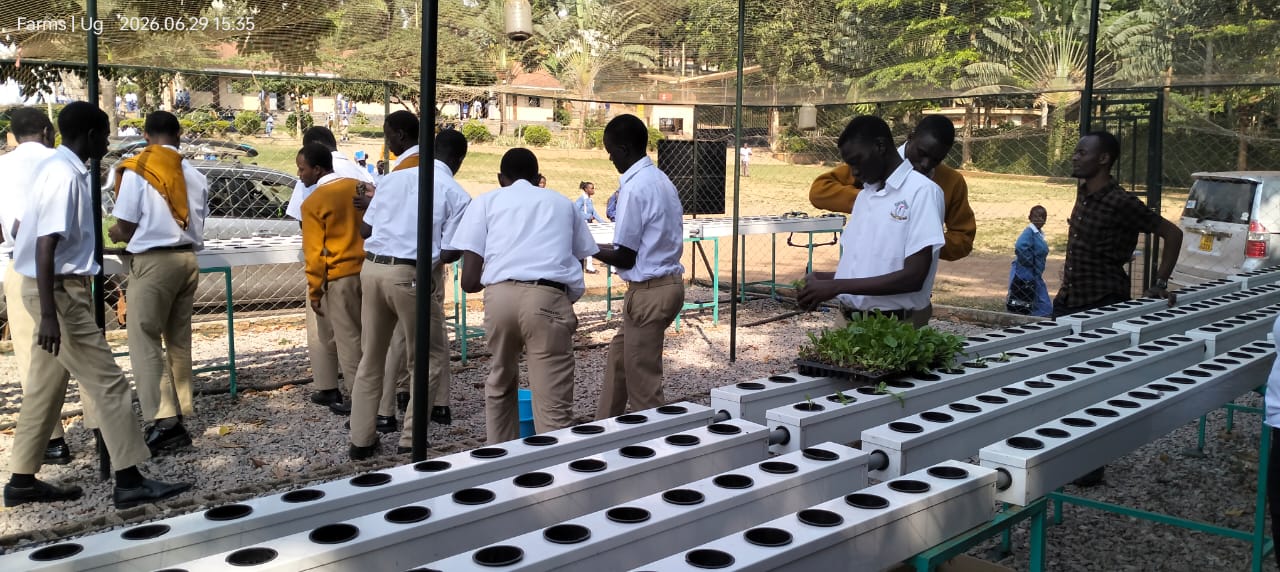
St. Kizito Secondary School – Namugongo
Students receive practical exposure to hydroponic farming, modern food production, water management and climate-smart agriculture through hands-on learning.
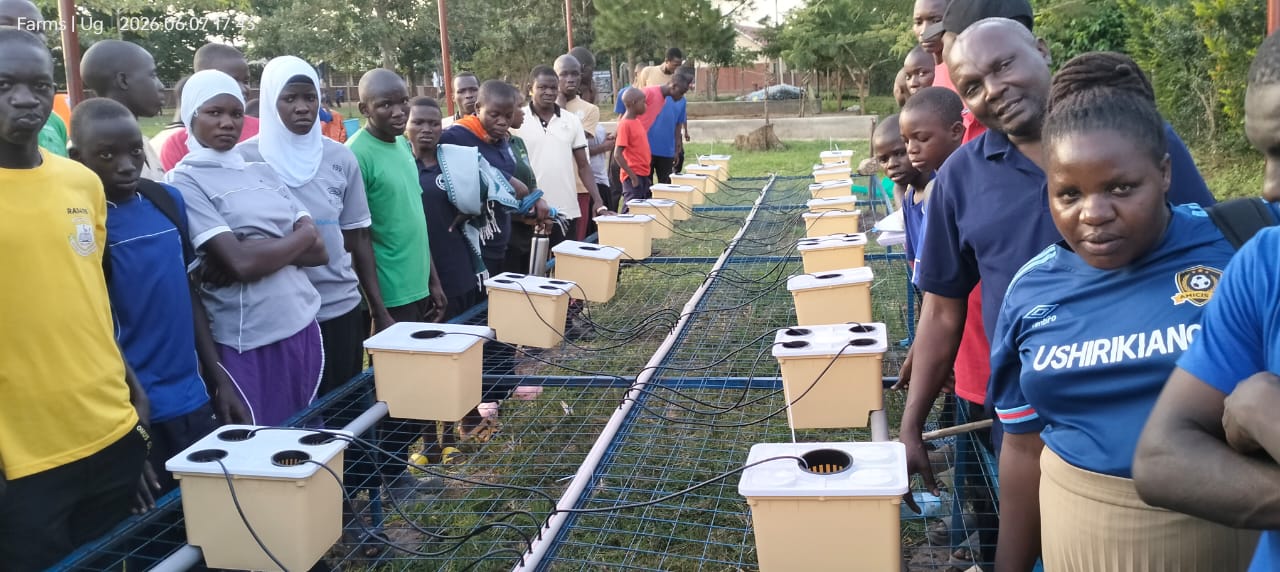
Rubongi Army Secondary School – Tororo
A school hydroponic garden designed to demonstrate sustainable food production while giving learners practical exposure to agriculture and STEM.
From Classroom Project to School Food & Enterprise Hub
The strongest school programmes connect education with responsible operation and measurable outcomes.
Frequently Asked Questions
Answers for school leaders, teachers, parents, development partners and students considering hydroponic farming in education.
What is hydroponic farming for schools?
It is a practical learning approach in which students grow crops without soil using nutrient-rich water. A school hydroponic garden can support agriculture, biology, chemistry, environmental science, technology and entrepreneurship education.
Can hydroponics be used to teach STEM in Ugandan schools?
Yes. Students can study plant biology, pH, nutrient concentration, water circulation, pumps, solar energy, sensors, measurements and data collection using a working farm as their learning environment.
Which crops can a school grow hydroponically?
Crop choice depends on the hydroponic system, local conditions and school objectives. Suitable systems can support leafy vegetables and selected fruiting crops. We recommend choosing crops after the school’s needs and site have been assessed.
Does a school need a large amount of land?
No. One advantage of hydroponic systems is that they can be configured for relatively compact spaces. The available area helps determine the appropriate layout and capacity.
Does hydroponics require a lot of water?
Recirculating systems reuse nutrient solution rather than continuously applying water to soil. Good design, maintenance and management are important for achieving efficient water use.
Can students participate in managing the system?
Yes. Schools can establish an agriculture or STEM club and assign supervised duties such as crop observation, record keeping, checking water levels and maintaining cleanliness.
Can a school hydroponic garden generate income?
Where appropriate, schools can teach entrepreneurship through production planning, costing, record keeping and sale of surplus produce. The model should be designed around the school’s educational, nutrition and sustainability objectives.
Do you train teachers and students?
Hydroponic Farms Uganda can combine installation with practical orientation and training so the school team understands operation, crop management and basic maintenance.
Can hydroponics be combined with solar power and sensors?
Depending on the system design, projects can incorporate solar-powered equipment, timers and monitoring technologies. These features can also expand the project’s STEM learning opportunities.
How can our school start a hydroponic project?
Start with a discussion about the school’s goals, available space, learner numbers and infrastructure. Hydroponic Farms Uganda can then help develop an appropriate system concept and quotation.
Ready to Build a School Hydroponic Garden?
Talk to Hydroponic Farms Uganda about a system for your school, STEM club, agriculture programme, NGO education project or institutional demonstration centre.
